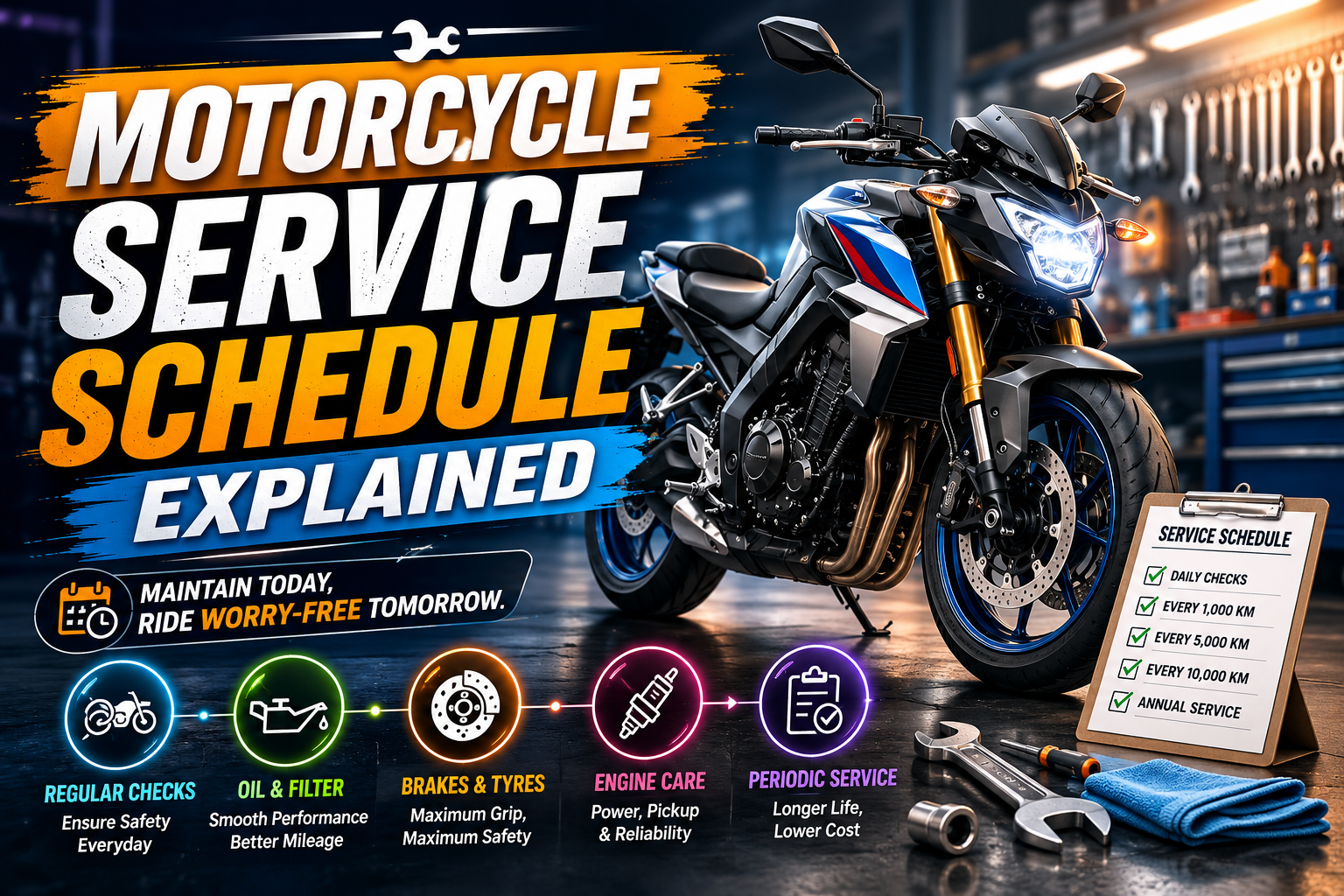
Motorcycle mechanic servicing a motorcycle while following a maintenance checklist in a professional workshop.
I used to think motorcycle servicing was simple.
Change the oil occasionally.
Keep fuel in the tank.
Ride.
Unfortunately, motorcycles don’t work that way.
One of my friends learned this the hard way when he ignored his service schedule for nearly a year. What started as a small maintenance delay eventually resulted in worn brake pads, a stretched chain, and an expensive repair bill.
The reality is simple:
Motorcycles last longer, perform better, and stay safer when serviced on schedule.
Whether you own a commuter bike, sport bike, cruiser, touring motorcycle, or adventure machine, understanding your service schedule is one of the most important parts of motorcycle ownership.
This guide explains exactly what should be inspected, serviced, and replaced throughout your motorcycle’s life.
Table of Contents
- Quick Answer
- Why Motorcycle Service Schedules Matter
- Understanding Service Intervals
- Pre-Ride Inspections
- Weekly Maintenance Tasks
- Monthly Maintenance Tasks
- Every 3,000–5,000 Miles
- Every 6,000–10,000 Miles
- Annual Maintenance
- Major Service Intervals
- Signs Your Motorcycle Needs Service
- Common Service Mistakes
- Service Checklist
- FAQs
- Final Thoughts
Quick Answer
A motorcycle service schedule is a planned maintenance timeline that outlines when to inspect, clean, adjust, lubricate, or replace critical components such as engine oil, filters, brakes, chain, tires, battery, and fluids. Following the manufacturer’s service schedule helps improve safety, reliability, and motorcycle lifespan.
Key Service Schedule Facts
| Service Item | Typical Interval |
|---|---|
| Tire Pressure Check | Before every ride |
| Chain Inspection | Weekly |
| Chain Lubrication | Every 300–600 miles |
| Engine Oil Change | 3,000–5,000 miles |
| Oil Filter Change | With oil service |
| Brake Inspection | Monthly |
| Air Filter Inspection | 6,000–10,000 miles |
| Coolant Replacement | Every 2 years |
| Brake Fluid Replacement | Every 2 years |
| Spark Plug Inspection | 6,000–12,000 miles |
1. Why Motorcycle Service Schedules Matter
Regular servicing helps prevent:
- Unexpected breakdowns
- Costly repairs
- Reduced fuel economy
- Poor handling
- Engine wear
- Safety hazards
Routine maintenance is significantly cheaper than repairing neglected components.
2. Understanding Service Intervals
Motorcycle service schedules are usually based on:
Mileage
Example:
- Every 3,000 miles
- Every 6,000 miles
- Every 12,000 miles
Time
Example:
- Every month
- Every year
- Every two years
Always follow whichever comes first.
A motorcycle ridden infrequently still requires maintenance because fluids and components age over time.
3. Pre-Ride Inspections
Before every ride, check:
✓ Tire pressure
✓ Tire condition
✓ Brake operation
✓ Lights
✓ Fuel level
✓ Chain condition
✓ Fluid leaks
✓ Mirrors
A five-minute inspection can prevent major problems.
4. Weekly Maintenance Tasks
Perform these checks weekly:
Chain Inspection
Check for:
- Proper tension
- Rust
- Wear
- Lubrication
Tire Condition
Inspect for:
- Cracks
- Embedded objects
- Uneven wear
Fluid Levels
Verify:
- Engine oil
- Coolant
- Brake fluid
5. Monthly Maintenance Tasks
Each month, inspect:
Brakes
Check:
✓ Pad thickness
✓ Rotor condition
✓ Brake response
Battery
Inspect:
✓ Terminal connections
✓ Corrosion
✓ Charge level
Controls
Ensure smooth operation of:
- Throttle
- Clutch
- Brake levers
6. Every 3,000–5,000 Miles
This is one of the most common motorcycle service intervals.
Tasks often include:
Engine Oil Change
Fresh oil helps:
- Reduce wear
- Improve cooling
- Extend engine life
Oil Filter Replacement
Replace the filter whenever oil is changed.
General Inspection
Inspect:
✓ Fasteners
✓ Hoses
✓ Electrical connections
✓ Suspension components
7. Every 6,000–10,000 Miles
At this interval, motorcycles often require more detailed servicing.
Air Filter Inspection
A dirty filter can reduce:
- Power
- Fuel efficiency
- Engine performance
Spark Plug Inspection
Check for:
- Wear
- Carbon buildup
- Damage
Fuel System Inspection
Inspect:
✓ Fuel lines
✓ Fuel filter
✓ Injectors or carburetor
8. Annual Motorcycle Service
Even low-mileage motorcycles need yearly maintenance.
Annual service should include:
✓ Comprehensive inspection
✓ Fluid checks
✓ Battery testing
✓ Tire inspection
✓ Brake inspection
✓ Suspension evaluation
9. Major Service Intervals
Major services often occur around:
- 12,000 miles
- 15,000 miles
- 24,000 miles
Tasks may include:
Valve Clearance Inspection
Important for engine performance and longevity.
Coolant Replacement
Prevents overheating and corrosion.
Brake Fluid Replacement
Maintains braking performance.
Wheel Bearing Inspection
Ensures smooth and safe handling.
10. Chain Service Schedule
Chains require frequent attention.
Inspect
Weekly
Lubricate
Every 300–600 miles
Adjust
As needed
Replace
When wear limits are reached
Neglecting the chain can damage sprockets and reduce performance.
11. Tire Service Schedule
Tires should be:
Checked
Before every ride
Inspected
Weekly
Replaced
When:
- Tread is worn
- Sidewalls are cracked
- Damage is present
Tires are among the most important safety components.
12. Battery Service Schedule
Battery maintenance includes:
✓ Monthly inspections
✓ Terminal cleaning
✓ Voltage checks
✓ Smart charging during storage
Most motorcycle batteries last between three and five years.
13. Signs Your Motorcycle Needs Service
Watch for warning signs such as:
Poor Starting
May indicate battery or fuel system issues.
Reduced Fuel Economy
Could signal maintenance needs.
Unusual Noises
Never ignore:
- Grinding
- Clicking
- Knocking
Poor Braking
Requires immediate attention.
Rough Idle
May indicate fuel or ignition problems.
14. Common Service Mistakes
Ignoring the Owner’s Manual
Manufacturer recommendations exist for a reason.
Delaying Oil Changes
Old oil increases engine wear.
Skipping Chain Maintenance
A neglected chain shortens drivetrain life.
Ignoring Small Problems
Minor issues often become expensive repairs.
Using Incorrect Parts
Always use quality replacement components.
15. Motorcycle Service Checklist
Before Every Ride
✓ Tires
✓ Brakes
✓ Lights
✓ Fluids
✓ Chain
Weekly
✓ Tire inspection
✓ Chain inspection
✓ Fluid levels
Monthly
✓ Battery inspection
✓ Brake inspection
✓ Control inspection
Annually
✓ Full service
✓ Fluid replacement checks
✓ Comprehensive inspection
Frequently Asked Questions
How often should a motorcycle be serviced?
Follow the manufacturer’s schedule, but basic inspections should occur before every ride.
Is annual servicing necessary if I don’t ride much?
Yes. Fluids, seals, and components can deteriorate over time.
How often should motorcycle oil be changed?
Typically every 3,000–5,000 miles, depending on the motorcycle and oil type.
What is the most important maintenance task?
Regular oil changes and safety inspections.
How often should I lubricate my chain?
Generally every 300–600 miles.
Can I service my motorcycle myself?
Many routine tasks can be performed at home with proper tools and knowledge.
Why is brake fluid replacement important?
Brake fluid absorbs moisture over time and can reduce braking performance.
How long do motorcycle batteries last?
Most last between three and five years.
What happens if I skip services?
Performance, reliability, safety, and component lifespan may suffer.
Where can I find my motorcycle’s service schedule?
In the owner’s manual.
Final Thoughts
A motorcycle service schedule isn’t just a maintenance recommendation.
It’s a roadmap to safer riding, better performance, and longer motorcycle life.
The most reliable motorcycles aren’t always the newest or most expensive.
They’re the ones that receive consistent care.
By following a proper service schedule, inspecting your motorcycle regularly, and addressing problems early, you can enjoy thousands of trouble-free miles while protecting your investment.
Take care of your motorcycle, and it will take care of you on every ride.